
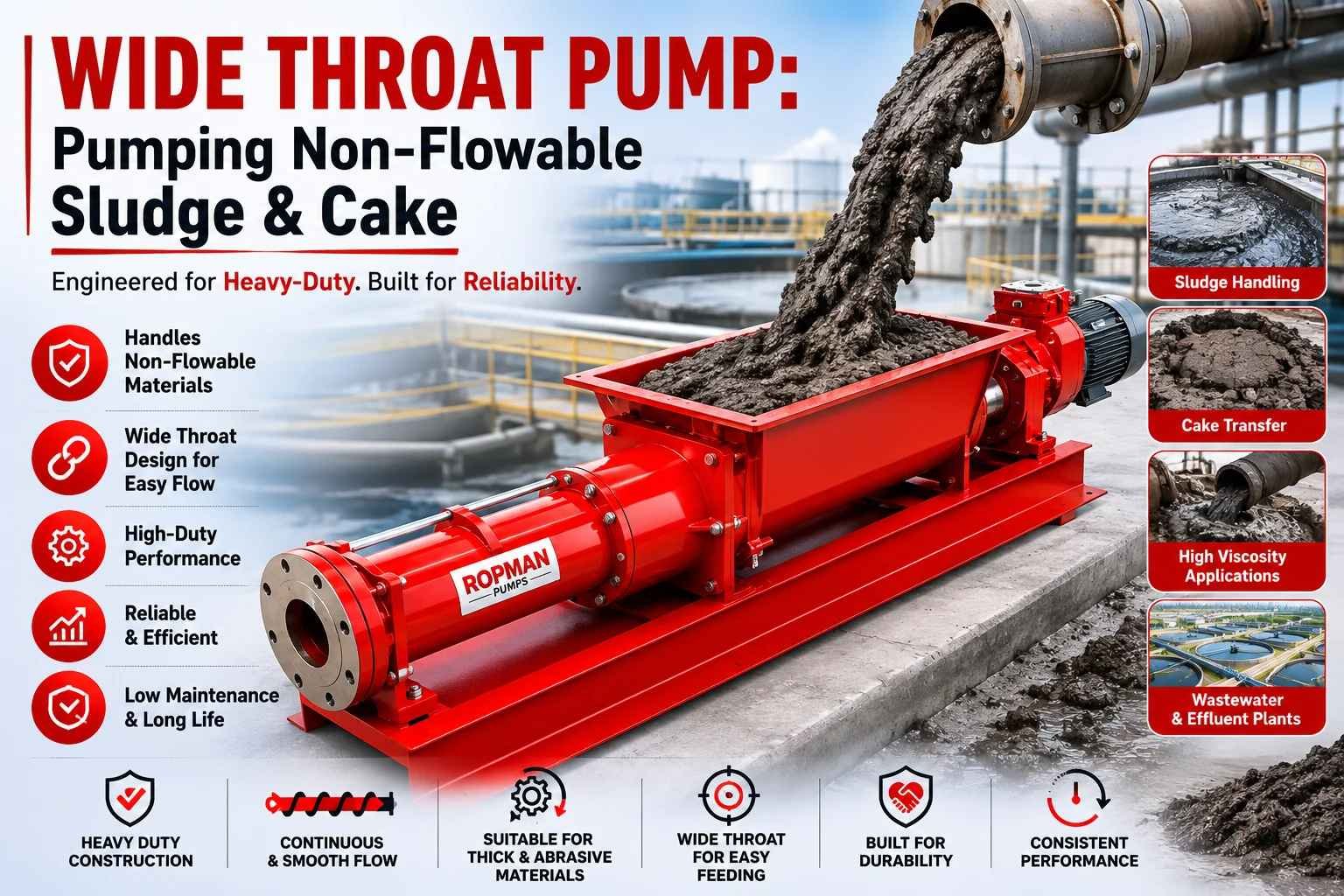
Wide Throat Pump: Pumping Non-Flowable Sludge & Cake
When sludge is too thick to flow into a normal pump, the wide throat design is what gets it moving.
Quick Answer
A wide throat pump is a progressive cavity pump with an oversized rectangular inlet and an auger feed screw, built to handle thick, sticky, non-flowable material like dewatered sludge, filter cake, and paste. The large throat stops the material from bridging above the inlet, while the auger forces it into the pumping element. It moves media that ordinary pumps simply cannot pull in.
Some materials are too thick to flow on their own. Dewatered sludge, filter-press cake, and heavy pastes will sit in a heap and refuse to drop into a normal pump inlet. This is exactly the problem a wide throat pump is designed to solve.
If your process handles high-solids media that clogs or starves standard pumps, understanding the wide throat design will save you constant blockages and downtime. Let’s look at how it works, where it is used, and how to choose the right one. For the underlying mechanism, see this overview of the progressing cavity pump.
What Is a Wide Throat Pump?
A wide throat pump is a special version of the progressive cavity pump built for material that will not flow by itself. Instead of a normal round suction port, it has a large rectangular hopper opening — the “wide throat” — sitting directly above an auger feed screw.
The two features work as a team. The oversized opening lets thick material drop in without arching or bridging, and the auger screw actively conveys that material sideways into the rotor and stator, where normal pumping takes over. Together they force non-flowable media into the pump that would otherwise never reach it.
How a Wide Throat Pump Handles Non-Flowable Media
The magic of a wide throat pump is in the feed zone, not the pumping element. Here is what happens step by step.
1. The Wide Throat
- A large rectangular hopper opening receives thick material.
- The generous width stops sludge and cake from bridging above the inlet.
- Material drops in under gravity instead of needing to flow.
2. The Auger Feed Screw
- A rotating screw conveys the material sideways.
- It forces non-flowable paste into the pumping element.
- An extended pitch handles high dry-solid content.
Once the material reaches the rotor and stator, the pump behaves like any progressive cavity pump — moving it in sealed cavities with smooth, gentle, positive displacement flow. The wide throat and auger simply solve the hardest part: getting the material in.
A standard pump waits for material to flow to it. A wide throat pump goes and gets the material — which is why it succeeds where ordinary pumps starve and stall.
Where Is a Wide Throat Pump Used?
Any industry that deals with thick, dewatered, or high-solids material relies on this pump for transfer duties. Common applications include:
- Wastewater treatment — dewatered sludge and filter-press cake from STPs and ETPs.
- Sugar industry — press mud and thick massecuite.
- Food processing — fruit pomace, dough, and thick pastes.
- Chemical & mineral — filter cake and thick slurries.
- Biogas & biomass — solid substrate and digestate feeding.
- Paper industry — high-consistency pulp and paper sludge.
Wide Throat Pump vs Standard Progressive Cavity Pump
The difference is entirely in the inlet and feed. This comparison shows when you actually need a wide throat pump instead of a standard unit.
| Feature | Standard PC Pump | Wide Throat Pump |
|---|---|---|
| Inlet | Round, standard size | Large rectangular hopper |
| Feed aid | None | Auger feed screw |
| Best for | Flowable liquids & slurries | Thick, non-flowable sludge & cake |
| Solids handling | Moderate | Very high dry-solid content |
| Bridging risk | High with thick media | Very low |
How to Choose the Right Wide Throat Pump
Specifying one correctly comes down to describing the material honestly and matching the feed design to it.
Your wide throat pump selection checklist:
- Dry solids percentage — the higher the solids, the more aggressive the auger and throat must be.
- Material behaviour — is it sticky, fibrous, or crumbly? This shapes the feed screw design.
- Flow rate and distance — how much, and how far it must be pushed.
- Abrasion — grit and sand decide rotor coating and stator hardness.
- Stator elastomer — matched to fluid chemistry and temperature.
- Bridge breaker — very stiff cake may need paddles to keep material feeding.
Getting these details right the first time is the difference between a pump that runs for years and one that jams within weeks.
Why In-House Manufacturing Makes a Difference
A pump like this is only as reliable as its rotor, stator, and auger. When these are produced in-house, the feed geometry can be tuned to your exact material, and spares arrive fast when you need them.
At Ropman Engineering Corporation, wide throat pumps and their rotors and stators are manufactured in-house in Meerut, India — so the throat size, auger pitch, and elastomer are matched to your sludge or cake, not to a generic catalogue. Explore our full progressive cavity pump range to see the options. For background on the material itself, see this reference on sewage sludge.
Frequently Asked Questions
What is a wide throat pump used for?
How is a wide throat pump different from a normal PC pump?
What solids content can a wide throat pump handle?
Does a wide throat pump need a bridge breaker?
Which industries use wide throat pumps most?
Conclusion
When material is too thick to flow, an ordinary pump simply starves. The wide throat pump solves that with two clever features — a large hopper inlet that prevents bridging, and an auger that forces the media into the pumping element.
Choose the right wide throat pump for your solids content and material behaviour, and you get reliable, blockage-free transfer of the toughest sludge and cake in your plant.
Handling Thick Sludge or Cake? We Can Help.
Ropman builds wide throat pumps with in-house rotors, stators, and augers matched to your material. Tell us your solids content and flow, and we will size the right pump.
Talk to Our Engineers